26 April 2026

Share
26 April 2026
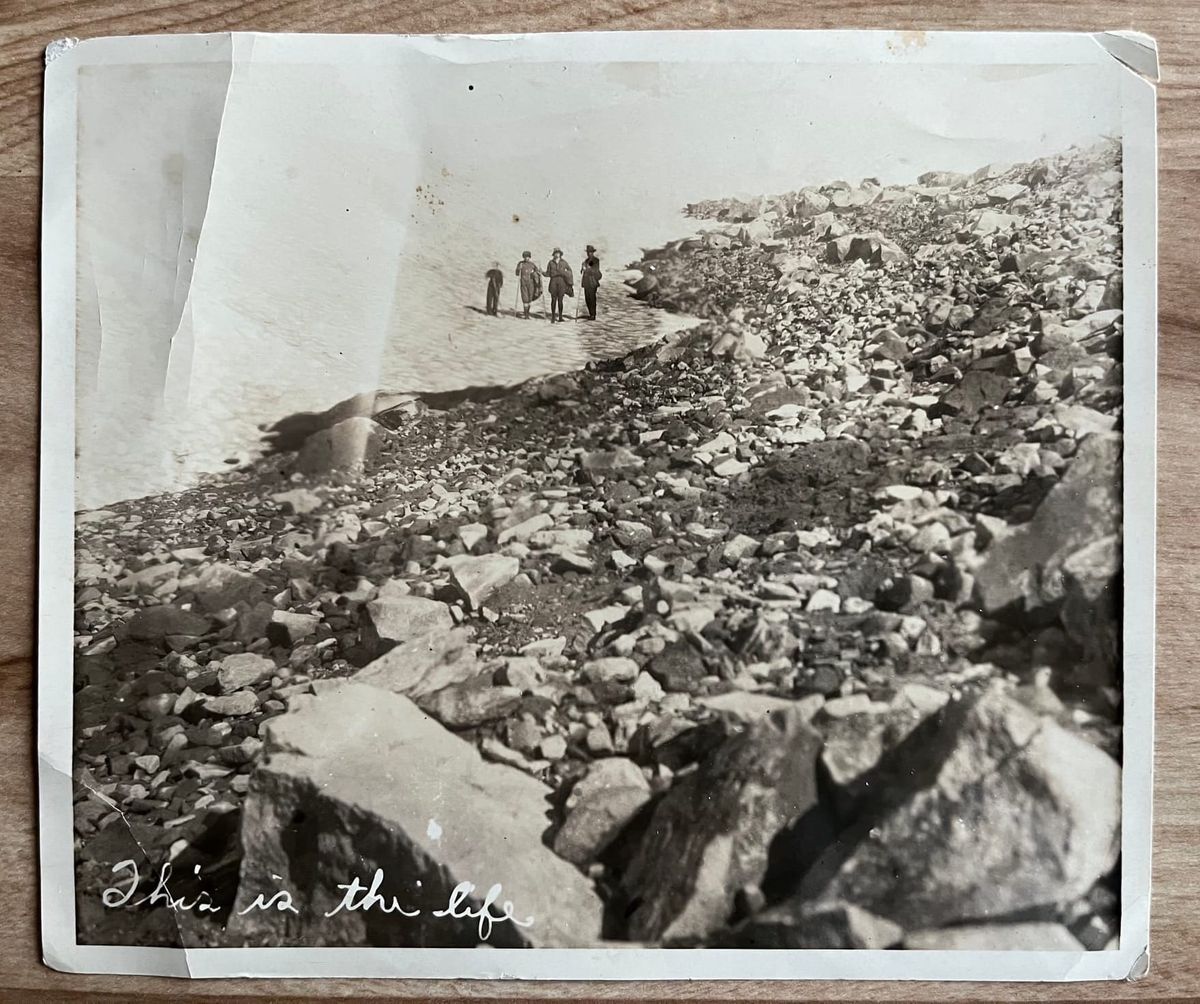
"This is the life.” A vintage photo of a family standing at the edge of a glacier. Paradise Valley, Washington. (Purchased at Kenton Antiques in Portland in about 2015.)
I took a break from letter-writing for the last month—postcards, too—to absorb some life events/changes. The changes are still unfolding (when do they stop?) and so I’m mostly just trying to stay present in this liminal space. Letting go of regrets about past losses, visualizing a fulfilling future without banking on one path to arrive there.

In an interview with ambient musician/producer Andrew Heath he recalls Pauline Oliveros saying, “don’t build a career, build a community," and how that inspired him to keep working collaboratively, and ultimately create his label Driftworks. (With that name, of course I was attracted to the label's ethos.) This idea spoke to me, as well: creating among other creators, for the sake of nourishing each other’s practice and commitment to the daily work. Not just of their art, but of living. Perhaps treating living itself as an art—not a commodified product, like an influencer—but approaching daily life and our relationships with the reverence of an artist.

Oliveros, who died in 2016, was an electronic musician and composer, a constant collaborator, and the founder of the Deep Listening Institute. Reading more about her, I came across another quote from her:

In order for us to survive, there has to be creative action, creative expression at every level of society without exception. This feeling that one gets from realizing and expressing something of the spirit is missing. It’s not available to everyone, and it needs to be. This is … the passion of my life and why I keep doing what I’m doing. I think it’s essential to go on.

I copied this into a document that has dwelled on my desktop for the last two months, while I sporadically ruminated on why to keep writing with the world in this condition of physical and social degradation.

It’s the part about the expression of the human spirit that catches me. I’ve had several conversations with artist and writer friends in the last few years in which one of us has been so dispirited by the environmental decay, the political iniquity, the depraved individualism, the pathological consumption—I could go on and on—that we have thought about giving up on our art or letting anything we lovingly create out into a world bent on extracting profit from it, shouting it down, or throwing it away. The obvious reason to carry on making art is because your community needs you to.

A page from Chelsea Martin’s Tell Me Im An Artist. Chelsea was not one of the writers I’ve had that conversation with, but I think she would understand.

I have two stories to tell you, one about a day job and one about a whole life.

story #1: "you’re not the customer; you’re the product"

A few months ago at my weird desk job, the executive director began instructing employees and volunteers to use “an AI” (how he phrases it) for everyday tasks. One example directed at me: finding waterfront restaurants in Seattle for a group reservation. (I refused and got him a reservation the "old fashioned” way—by looking up restaurants on the internet and calling them from my cell phone.)

He didn’t care that I spent my formative years in Seattle; that I worked in Pike Place Market as a young adult; that your average search engine functions just fine for finding businesses (taking your money is the internet’s job, right?). New tech trumps human experience—especially the experience of an underpaid woman.

My boss, an archaeologist-by-training, nonprofit director-by-choice, is enthralled by the magical chatbox of the predictive text generator. (I’m trying not to get brand specific here). He spent an entire morning periodically shouting out from his office about how cool it is. How quick. How enthused the responses were, even when obviously wrong. He uploaded the short film of a documentarian recently under contract (without their permission, btw) into one of these generators, three times, to finally eke out an acceptable synopsis for the website. (Amazing!) He gushed about a wealthy business associate who had begun using the email's text generator to respond to his messages. And so on.

My boss, who seeks out and supposedly holds sacred the remnants of civilizations gone by, created a nonprofit media organization whose mission is to share “the human story.” I wondered, does he ever think about the archaeologists of the future? Of what artifacts of "the human story” will remain after data centers wreak drought and starvation across the planet? After skilled traditional craftspeople, elders and wisdom-keepers of cultures around the world are replaced by homogenized content creator slop, or, increasingly, are disappeared from their ancestral lands and the collective of humanity by AI warfare? What is the appeal, truly? Can I discount the childlike sense of wonder that he apparently has for this new tech? Don’t I want more people to cultivate a sense of wonder?

But it’s not wonder, at the heart of it. It’s this: these chatboxes deliver promptly (immediate gratification) and respond in a “yes, master; of course, master,” tone (like a minion, or...a slave). Unlike human underlings (hi there, it’s me again), who have material concerns, muscles of discernment, moral compasses, and—occasionally—the sheer chutzpah to say, “No. That’s a ridiculous request.”

Because it's the work itself that’s full of friction, right? Making an abstract vision into something material, communicating thought from one human mind to another, through image, sound, or word, is painstakingly difficult, tedious, and sometimes, even for those of us who supposedly love it, insufferable. There’s a compulsion to translate the inner, to communicate it with others and perhaps connect to their spirits, to perform an ineffable exchange. But capacity and ability can’t always compete with our physical conditions, our complicated, individual embodiments. We grow, we iterate cells for variable amounts of time. Our bodies weaken, they’re easily damaged, sickened. Our fucking feelings get hurt and it’s like a physical wound! Sometimes we heal and sometimes, without our understanding or even awareness, we don’t heal. We become accustomed to pain and trauma. Expressions of the spirit are vital, but not easy, not in these bodies.

So, I keep meditating on this. Like the Venn diagram from Chelsea Martin’s book: Why keep trying? Why give up? And why, for goodness' sake, bother to keep up the effort for such small, insignificant tasks as email, or a film synopsis? Isn’t it this work—these dumb little bits of communication that aren’t really important, (but somehow are, because it’s how we earn an hourly wage, or keep up relationships with people we never see in person)—that we should task off to the computers?

Unless you’re physically or cognitively disabled and these technological tools can help you communicate your experience with others and better your experience of life, then, no. I don’t think we should use them for these everyday tasks of language and social interaction. Here’s why: the ever-unspooling human story and its drift of earthly artifacts—whether tool, or art, or correspondence—are created through the accumulation of discrete, everyday actions to which it is necessary that we bring our whole, complicated selves. The friction is the point; it’s your spirit grinding, sparking, bumping, gliding up against embodied experience. It’s as true in art as it is in daily life. Our tools should help us communicate this internal experience, not insulate us from it, or deaden us to it.

So, as with all slippery slopes, greased poles, cliches, memes, etc., at my weird desk job, it all started with small, insignificant stuff, then rapidly became quantifiable and stupefying. Inevitably, my boss brought up using “an AI” for the scripts of the archaeology audio news podcast, which is researched, written, and edited by a handful of volunteers—often college students or recent graduates—about whom the e.d. often complains of inconsistency and irredeemable punctuation and grammar habits. Why not use the magic chatboxes instead—just for editing, at first, he proposed.

Since he bothered to ask (a shock, actually), the time had come for my one other female colleague (twenty years my junior; I love you, Gen Z commrades) and I to lay out our objections: the ethical, the environmental, the existential. (You can read about those elsewhere—and I suggest you do. I’ll put some links at the end.)

For my part, by way of a personal connection to the ethical issues involved, I told my boss about the fact that my two novels (the culmination of my education and years of my waking and dreaming life, and the only legacy I currently have to leave to my child), were among the hundreds of thousands of published works fed into the large language models that power these text generators, and that I am one of the thousands of authors currently part of the settlement with Anthropic over their unlicensed use of copyrighted works to train their LLMs. This is from The Authors Guild Bulletin article on the Bartz v. Anthropic settlement (see source list below):

Internal emails revealed that Anthropic’s leadership deliberately chose to “steal” books over lawful licensing to avoid what they called the “legal/practice/business slog.” This echoes the revelations emerging in other suits, including Kadrey v. Meta, where Meta’s use of criminal pirate sites LibGen and Z-Library was exposed, with a sign-off from CEO Mark Zuckerberg. Both cases show that AI companies have been downloading (and in the case of Meta, reuploading) pirated ebooks en masse to train LLMs with full knowledge at the highest level of decision-makers.

Again, note the avoidance of the tedious, unglamorous labor that goes into the creation, the invention, of a thing. It’s a slog, right? Negotiating and filling out licensing contracts? For thousands of copyrighted works? Pffft. Why bother? They’ll be so rich by the time they’re done, no one will be able to touch them.

In that same issue of The Authors Guild Bulletin, in an update on the Kadrey v. Meta case, this, let’s call it, judgmentally, laziness, becomes even more explicit.

As the court notes, Meta had a strong incentive to use books as training material due to their high quality and structural coherence, noting that “while a variety of text is necessary for training, books make for especially valuable training data” in improving the LLMs’ performance. Internal Meta communications showed repeated discussions about the value of books and the urgency to acquire more for training, with one employee saying that the “best resources we can think of are definitely books.”

I’ll say the quiet part out loud, here:

Books were the best sources for training LLMs (as opposed to social media posts, emails, or other accessible text that these companies scrape from our accounts legally per our user agreements) because of the time-intensive human labor and material investment (the learning, the thinking, the writing, the rumination, the revising, the editing, the fact-checking, the copyediting, etc.) that goes into published books, which had already been performed by the publishers and their partners-in-slowpoke-industry, the writers themselves. What a way to work smarter, not harder, right? Thievery. More time to rake in the investor funds, stock up on unregulated crypto, and outfit their apocalypse bunkers.

But back to the nonprofit office: you might wonder what my boss had to say about our, let’s call them, tenderly, misgivings? Would you be surprised if I told you he didn’t seem to hear them at all? That he compared the astronomical energy consumption and water usage of data centers to us, the workers, driving our cars to our jobs? That he hadn’t heard of Bartz v. Anthropic and that he seemed bewildered that I could have written anything these geniuses would bother stealing for their magic chatboxes? After all, his reaction implied (or maybe it dawned on me, alone, in that moment), what was I doing working for him, if I was such a good and successful writer? I should be so lucky, to have my work transformed into such a serviceable tool for the likes of himself.

The next day, he called my overworked female colleague into his office and pronounced (so the whole office could hear, per usual) that he thought the magical chatbox could write better social media posts than she did.

Reader: I quit.

On a Friday morning, after he stood over me at my desk and demanded I comply with an asinine request (not even “an AI” request, just an redundant task)—like a robot—I gathered my stuff and walked out of the office without a word. And though it was tedious, and took more time of my glorious life than I gave a fuck to spend: I wrote my resignation email without the help of predictive text generation.

Not my resignation, sadly, but a postcard I bought at the below-mentioned estate sale, resting on my dirty counter with vinegar & the butter dish. From the back: "The" India ink and pencil manuscript, Marcel Duchamp, 1915.

story #2: the estate sale

Yesterday, on our way to share fish and chips, Rian pulled over at an estate sale. It was in a beautiful old craftsman, shaded by tall firs, with lilacs in full bloom on either side of the front steps. Treasure hunters flowed in and out of the house. People were smiling; there was an air of curiosity, delight. We bumped into each other as we rounded corners, stopped to comb the tables and shelves. There were good-humored apologies, shared remarks about the items for sale, and the previous owner. She was a collector. I think she was an artist. As we climbed the stairs to the second floor, a lingering odor of decay came over us. We kept climbing. In a small room at the top: her clothes. She was a stylish lady. Petite. Saks Fifth Avenue. Silk. They dont make them like this anymore. It was the third day of the sale. Small things remained: a collection of creamers; cups and pots, handmade or California pottery; leather and velvet and quilted wallets. Also, framed art prints, abstract expressionist. And landscapes: black and white photographs. Against the walls: an eclectic assortment of vintage and antique chairs—some of them pricey, some not. In the living room I found a box of postcards, collected from museum visits around the country: Marcel Duchamp, Alice Neel, Jean Arp, Joan Brown, Fay Jones, David Hockney. She traveled the world looking at art. The wondering aloud about her artifacts, about her life—parent to child, partner to partner, stranger to stranger, murmuring through her house—reminded me of the Virginia Woolf story “A Haunted House.”

From room to room they went, hand in hand, lifting here, opening there, making sure—a ghostly couple.

Sifting through the remnants of someone’s life, in the very house they lived in, there’s a striking felt presence you don’t experience at the antique mall, or even, say, a curated museum exhibit. After a little digging, based on some clues in the ad for the estate sale on Craigslist and a dedication on a photo hanging in the stairwell, I found her obituary in the Register-Guard.

Turns out, I took home a dozen of Constance Louise James’s postcards. I plan to send them out (possibly to some of you reading this) as an expression of my spirit, and of Connie’s—seems like she knew what was what. It's one small, mundane act of resistance, of opting out of being the product.

I’ll leave you with this quote from another real one, artist and activist Molly Crabapple, in The Guardian (source link below):

In return for the entirety of the human and non-human world, the tech lords can only offer us dystopia. Their fantasy future contains neither meaningful work nor real communities, just robots chattering to each other, leaving nothing for us.

Okay, everyone? Let’s keep trying.

xo

Further reading/listening:

Driftworks - Home
Independent ambient music label specialising in quiet experimental electro acoustic and minimal neoclassical music often using field recordings.
Automatic Inscription Of Speech Melody, by Carrier Band
4 track album

One of Pauline Oliveros’s many collaborative electronic works.

Tell Me I’m An Artist
Check out Tell Me I’m An Artist - <b>“Portrait of the artist as a broke and brilliant, hungry and funny young woman” (Lynn Steger Strong, author of <i>Want</i>), this hilarious and incisive coming-of-age novel about an art student from a poor family struggling to find her place in a new social class of rich, well-connected peers is perfect for fans of Elif Batuman&rsquo;s <i>The Idiot</i> and Weike Wang&rsquo;s <i>Chemistry</i><br><br><br><i></i></b><br><br>At her San Francisco art school, Joey enrolls in a film elective that requires her to complete what seems like a straightforward assignment: create a self-portrait. Joey inexplicably decides to remake Wes Anderson&rsquo;s Rushmore despite having never seen the movie. As <i>Tell Me I&rsquo;m An Artist</i> unfolds over the course of the semester, the assignment hangs over her as she struggles to exist in a well-heeled world that is hugely different from any she has known.<br><br>Miles away, Joey&rsquo;s sister goes missing, leaving her toddler with their mother, who in turn suggests that Joey might be the selfish one for pursuing her dreams. Meanwhile, her only friend at school, the enigmatic Suz, makes meaningful, appealing art, a product of Suz’s own singular drive and talent as well as decades of careful nurturing by wealthy, sophisticated parents.<br><br>A masterful novel from an author known for her candid and searching prose, <i>Tell Me I&rsquo;m An Artist</i> examines the invisible divide created by class and privilege, ruminates on the shame that follows choosing a path that has not been laid out for you, and interrogates what makes someone an artist at all. by Chelsea Martin on Bookshop.org US!

Chelsea Martin’s brilliant story of artistic angst and class-consciousness in the blessed pre-AI days.

Recognizing AI Hype and How People Can Fight Back / Emily Bender and Alex Hanna
Dr. Emily M. Bender and Dr. Alex Hanna, come on the show to talk about their new book “The AI Con: How to Fight Big Tech’s Hype and Create the Future We Want” published by LitHub. The book tackles the pitfalls of AI and why it’s so crucial to understand the capitalist greed that is manipulating AI behind the scenes. A new installment of “This Week In Rotten History” from Renaldo Migaldi follows the interview. Help keep This Is Hell! completely listener supported and access bonus episodes by subscribing to our Patreon.

A podcast with Emily Bender and Alex Hanna, AI critics extraordinaire; intellectual heroes.

Is AI the greatest art heist in history?
New technologies of reproduction are plundering the art world – and getting away with it

They’re not just stealing printed works.

Liberation Toolbox by YK Hong
Liberatory Strategy + Tech Justice for our expansive world

I’ve learned a lot from YK Hong about opting out & I'm infinitely grateful that they continue to share their knowledge with every new horror the techno-fascists deliver.

Sources for quotes above:

“Cues,” Pauline Oliveros. The Musical Quarterly, Autumn, 1993, Vol. 77, No. 3. Available on JSTOR.

"Quote Origin: You’re Not the Customer; You’re the Product” Posted by quoteresearchJuly 16, 2017.

“Mixed Decision in Anthropic AI Case: Authors Guild Responds to Summary Judgment in Bartz v. Anthropic” The Authors Guild Bulletin, Winter 2025 - Spring 2026, p. 15-17.

“Legal Watch: Meta Gets a Technical Win but the Law Favors Authors” The Authors Guild Bulletin, Winter 2025 - Spring 2026, p. 54-55.

"Is AI the Greatest Art Heist in History” by Molly Crabapple, The Guardian. Sunday 12 April 2026.