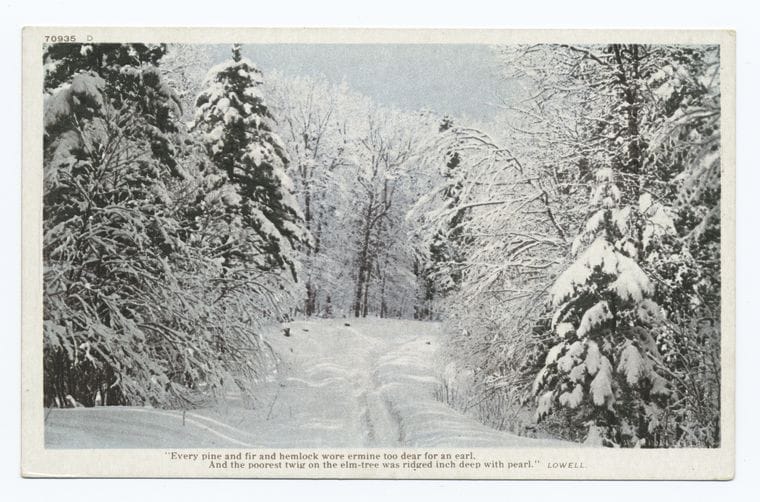
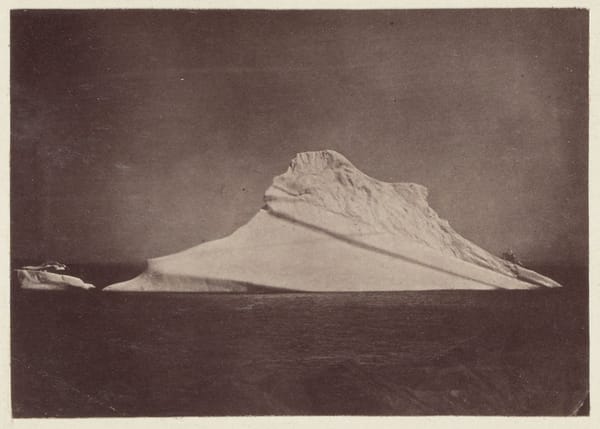
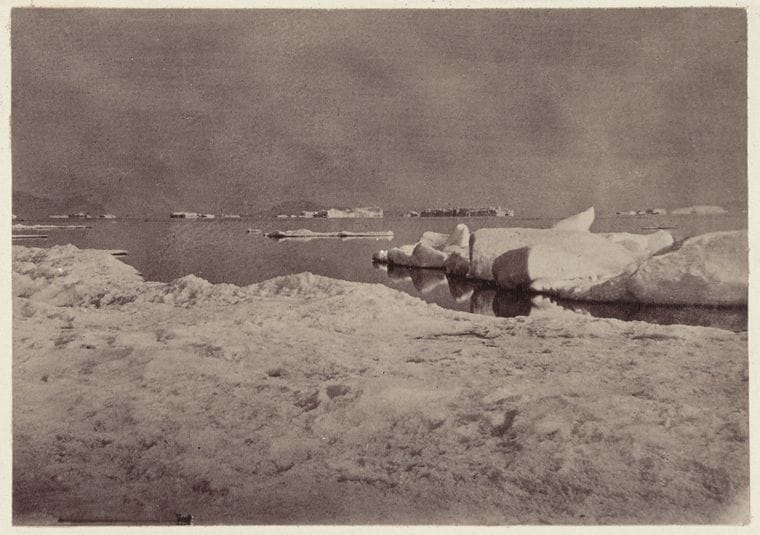
ephemera #1: to americans, to make much of time
This post was written while we all watched and rewatched videos circulating of a beautiful queer poet & mom being executed by ICE in her Minneapolis neighborhood, in front of her wife and neighbors. For those of you who watched the BLM protests, and the Gaza protests, and thought: that’s not me, I’ll protest with my vote, with my dollars to the ACLU and Southern Poverty Law Center (great, please do), I would like to offer this for your consideration: it feels empowering to demonstrate your dissent publicly, with your community, as more and more everyday Minnesotans have been doing.
As horrible as it sounds, this administration wants you to see what they’ve done to Renee Good and others, because they want you to be afraid & stay home. I most often see People of Color, Queer folks, Gen Z, veterans, and pissed off liberal Boomers (i.e. grandmas & grandpas!) at demonstrations here. They are not braver than anyone else, or more radical. Once you get out there, you realize that those violent incidents are rare, and we, the people, truly are stronger together. I’ve been so inspired by stories from Minneapolis, of normal people showing up for each other & what they believe in: safety, abundance, and a peaceful existence for everyone.
As I say to my kid, who is wracked with anxiety these days (like many kids about to graduate high school in this shitshow): there are more of us than them. Let’s show them that; let’s show up for each other and a life worth living.
I wasn’t going to share the following postcard poems in this post, but now is the time to show who we are and what we’re FOR. Even if it’s something as insubstantial as a piece of card stock with a haphazard poem on it. I stand for my mediocre collage poems, and all attempts to translate feeling into connection in the world. Down with false divisions. Down with fear. Down with scarcity mindsets. Up with mutual care. Up expansive visions of community. Up with everyday acts of resistance. One of my somatic healing teachers ends each class with this: “May the loving energy we cultivate reverberate out to all beings everywhere, seen and unseen, across space and time.” That’s what I’m for, damnit.
I’m planning a generative workshop centered around nurturing creativity amid polycrisis that will meet once a month on Zoom starting in February. My hope is that it will be an outlet and a point of connection for writers struggling with what and how to write in this moment. If you’re interested in taking part, you can reply to this email or use the form on my contact page. Tell your friends, too. Let’s see what we can make together.
On to the letter...
A brief history of my paper hoard & making shit to mail to friends & strangers.
If I hoard anything, it’s paper. By weight, books come first. By number, it’s probably postcards. I've collected postcards since I was probably 8 years old, when they were mostly Marilyn Monroe (not kidding, I still have at least 50 of them). When I was a teenager, my first girlfriend (Andy) and I wrote postcards to each other between Seattle and Portland. Hundreds. There were letters, too, but postcards were the texts of our day, quickly jotted off & almost as quickly forgotten. Some of them were a little spicy! (Someday, with Andy’s permission, they might be their own post.) If you were a zine-making teen in the '90s, you might have made your own postcards and sent them off to friends. I did, and I still have a couple that friends sent to me. I continued to send postcards well into the digital age, made a big deal of keeping up the practice in my last letter. When I receive one back—still, to this day—my heart flutters.
One of the first scenes that I wrote in Glaciers was Isabel finding a mysterious, intimate postcard at an antique shop on Hawthorne Boulevard in Portland. She, being my alter-ego, also collects postcards, and the short chapters are meant to be read like postcard scenes from her life. This construction was, as they say, on brand for me.
If you have sent me a postcard, I’ve kept it. I have one from the musician Jolie Holland, to whom I had sent an advance copy of Glaciers (I loved her music; we had mutual acquaintances). It’s lovely, suggesting we meet when she was in Portland next. She had forgotten me by then, though, because I approached her to introduce myself at the little cafe where she was playing in downtown Portland, and she looked completely mystified. She had sent this awkward stranger a postcard? Surely not… That postcard is all that remains of our brief connection.
Postcards: they’re easily forgotten. Think of all of your forgotten postcards and lost connections, filed in an old shoe box at an antique store, becoming some loner’s weird art project.
(I began taking pictures of some postcards, before I sent them out, so that I could remember what I’ve sent, and to whom.)
In 2018, my old friend Jonathan Curley started an art-in-the-mail project, where a dozen or so people from throughout his life would send each other art once a month. I don’t consider myself an artist, but I love folk art and found art. So I looked around and used what I had at hand. Here’s what I made:
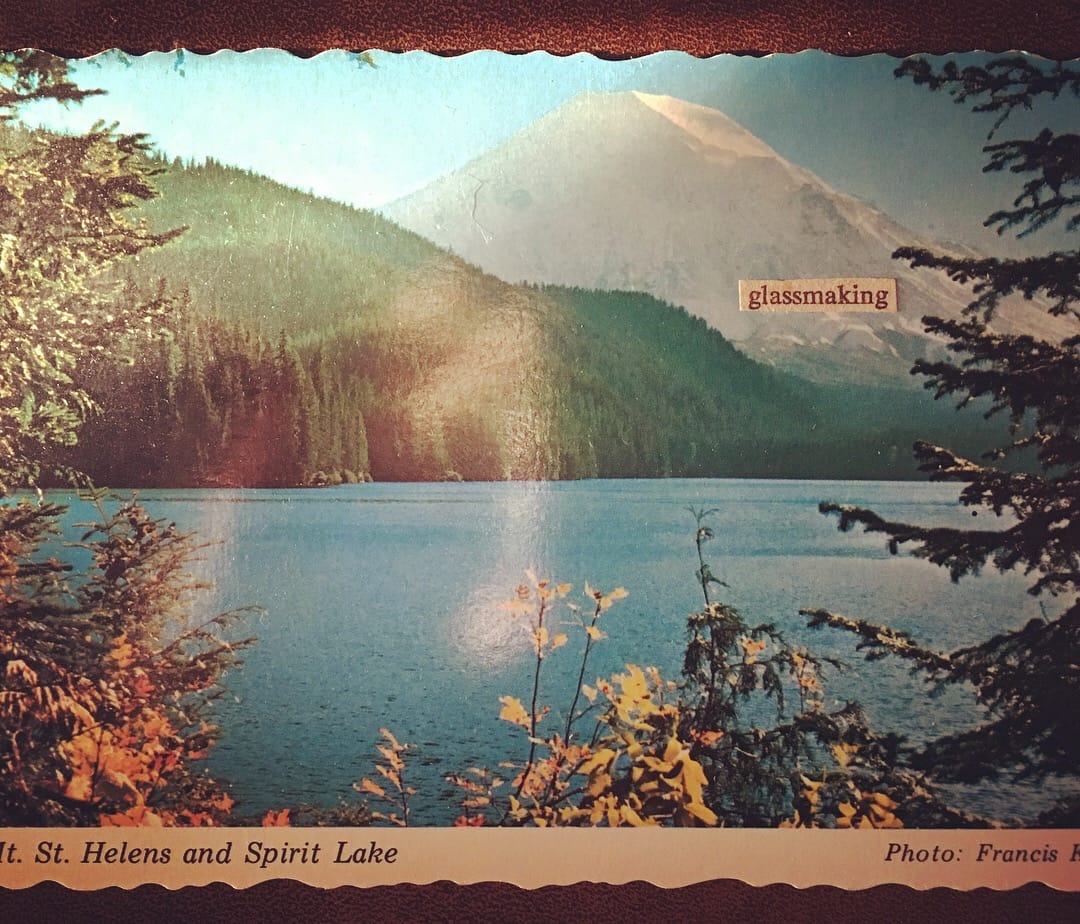
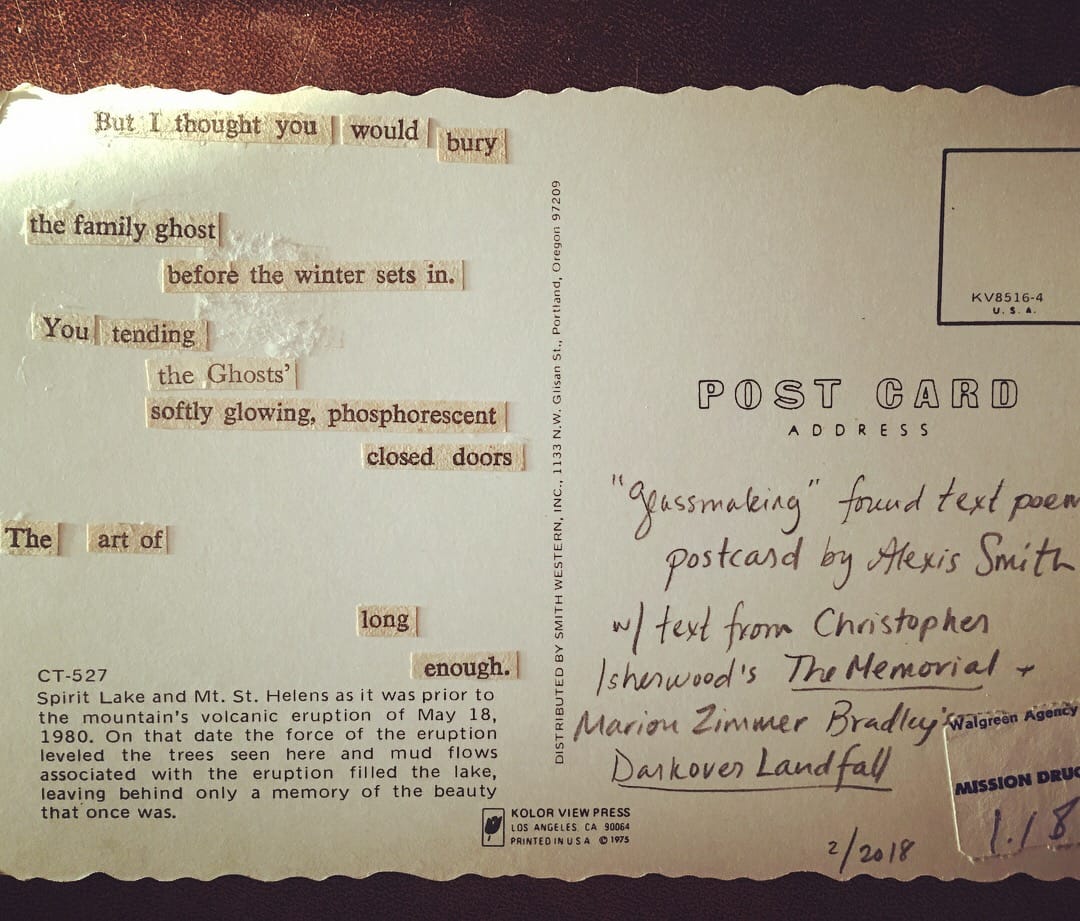
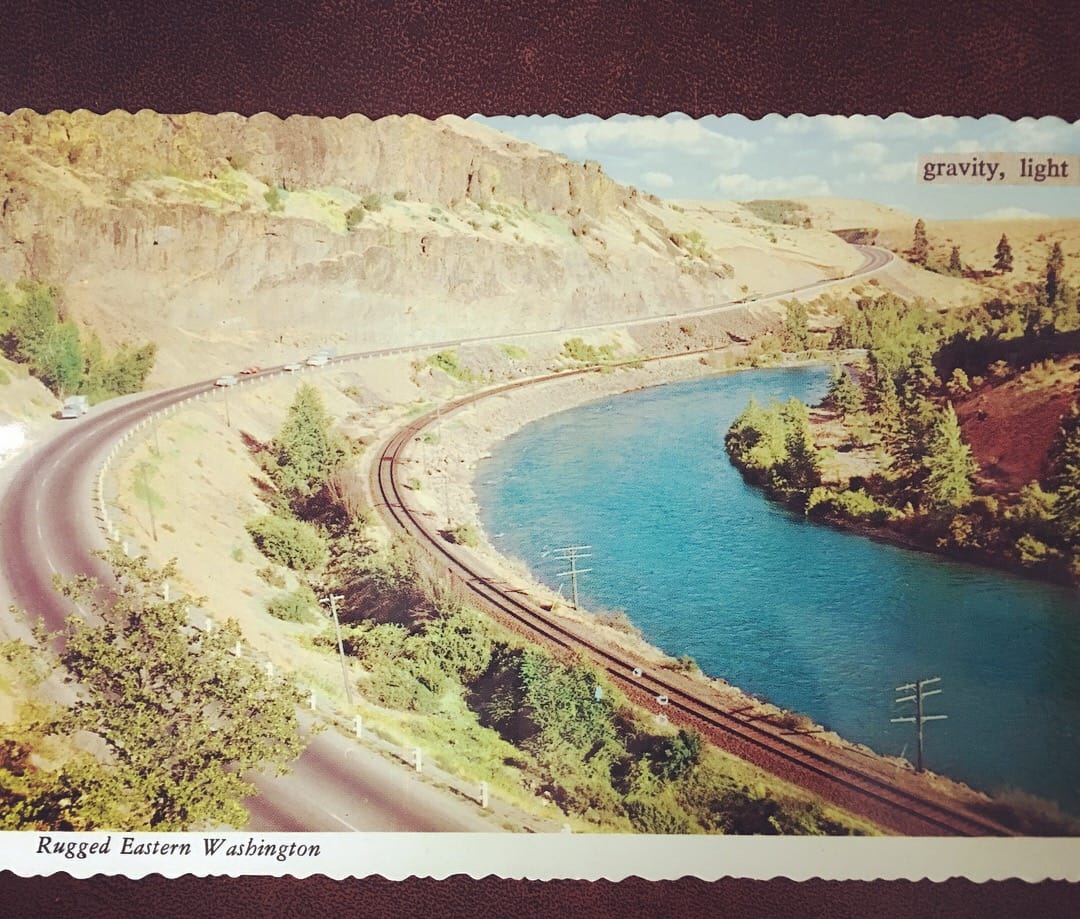
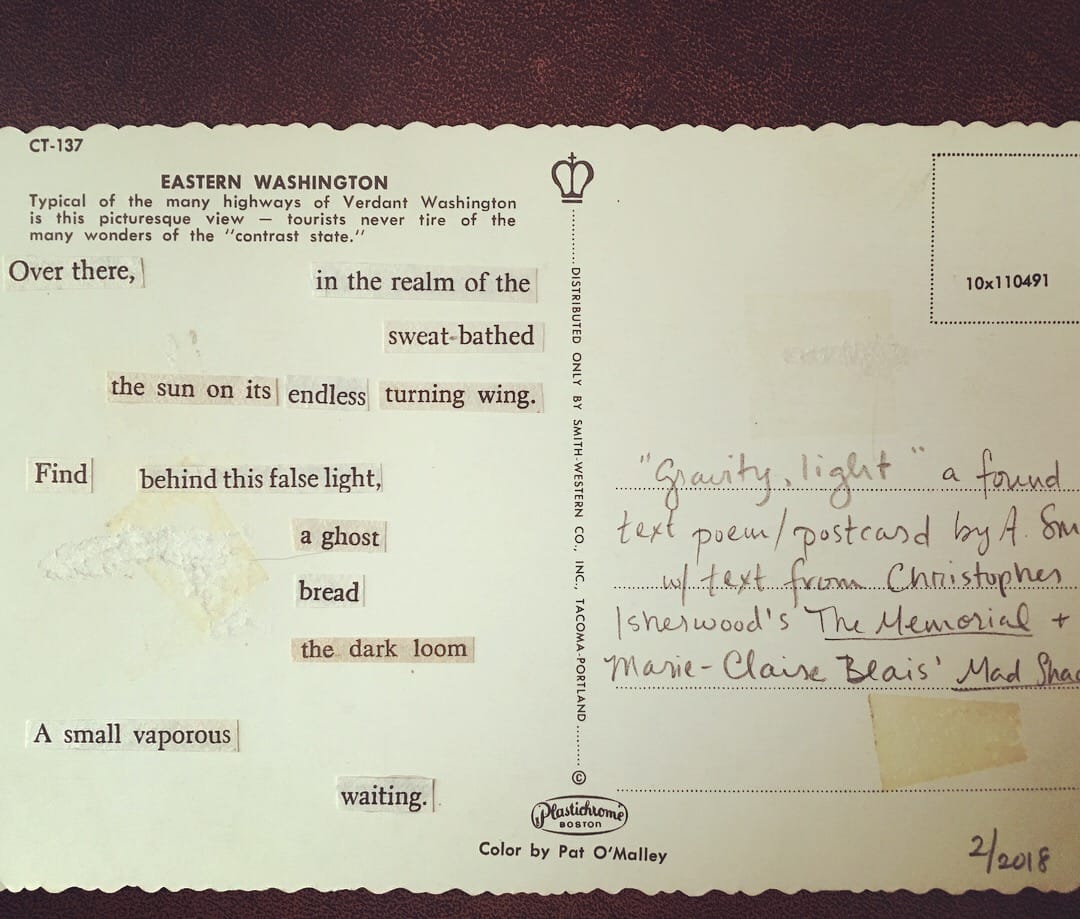
You could say I took “mail art” too literally: two of the collage poems I photographed before mailing off to strangers (in envelopes).
I think glassmaking on the image of the pre-eruption Mt. St. Helens is my favorite. Ceramicists would later take ash from the eruption to make glazes for pottery. Who knows if the person I sent it to made that connection?
Incidentally, I received an actual brick in the mail from another participant (whose name is also forgotten, sadly), stamped with the words ENOUGH IS ENOUGH. (That might be my next protest sign.) I still have it. It’s the perfect paper weight.
During the pandemic lockdown, I was alone in a dilapidated, 100-year-old, three-story rowhouse on South Walnut Street in Spokane. It was a strange time, in a strange space, alone with my three cats and my kid. We didn’t have a “pod.” We didn’t see anyone in my family (just over the mountains in Seattle) for seven or eight months. Periodically, I drove to Boardman, Oregon—halfway to Portland—where we met my kid’s dad in the parking lot of the Love’s truck stop so he could go stay with his other parents for a while.
Alone, I listened to a lot of murder podcasts. I started doing The Class, a somatic movement practice, in my attic space (I still do it, in my office). I spent hours at the community garden where I was a steward, tending beds, watering, weeding. I didn’t write. Fiction was out of reach in that surreal space and time. But I started making collage poems and ephemera art again, with old photographs and other stuff stashed away in my stationery box (a mustard yellow Amelia Earhart travel case).
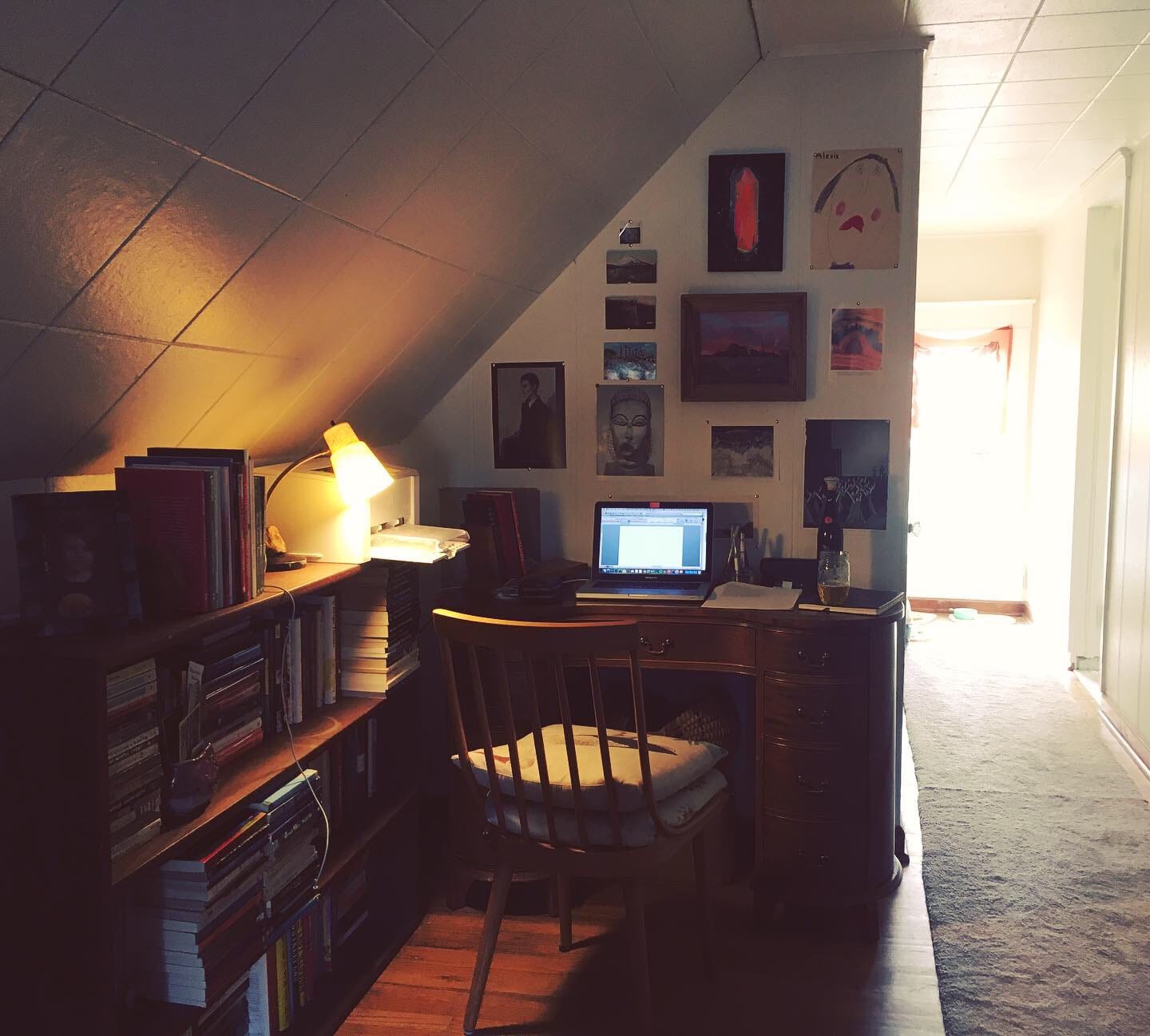
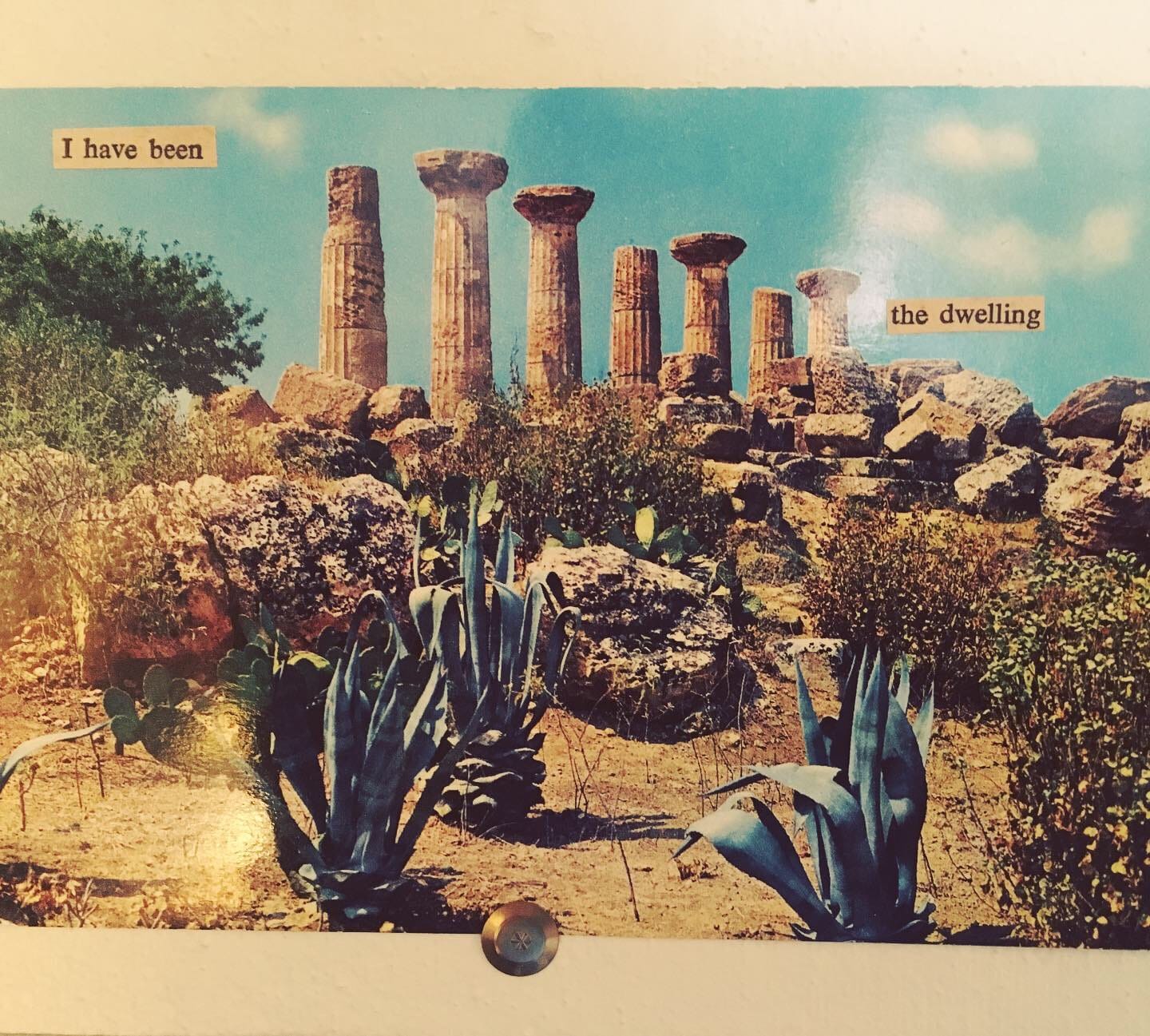
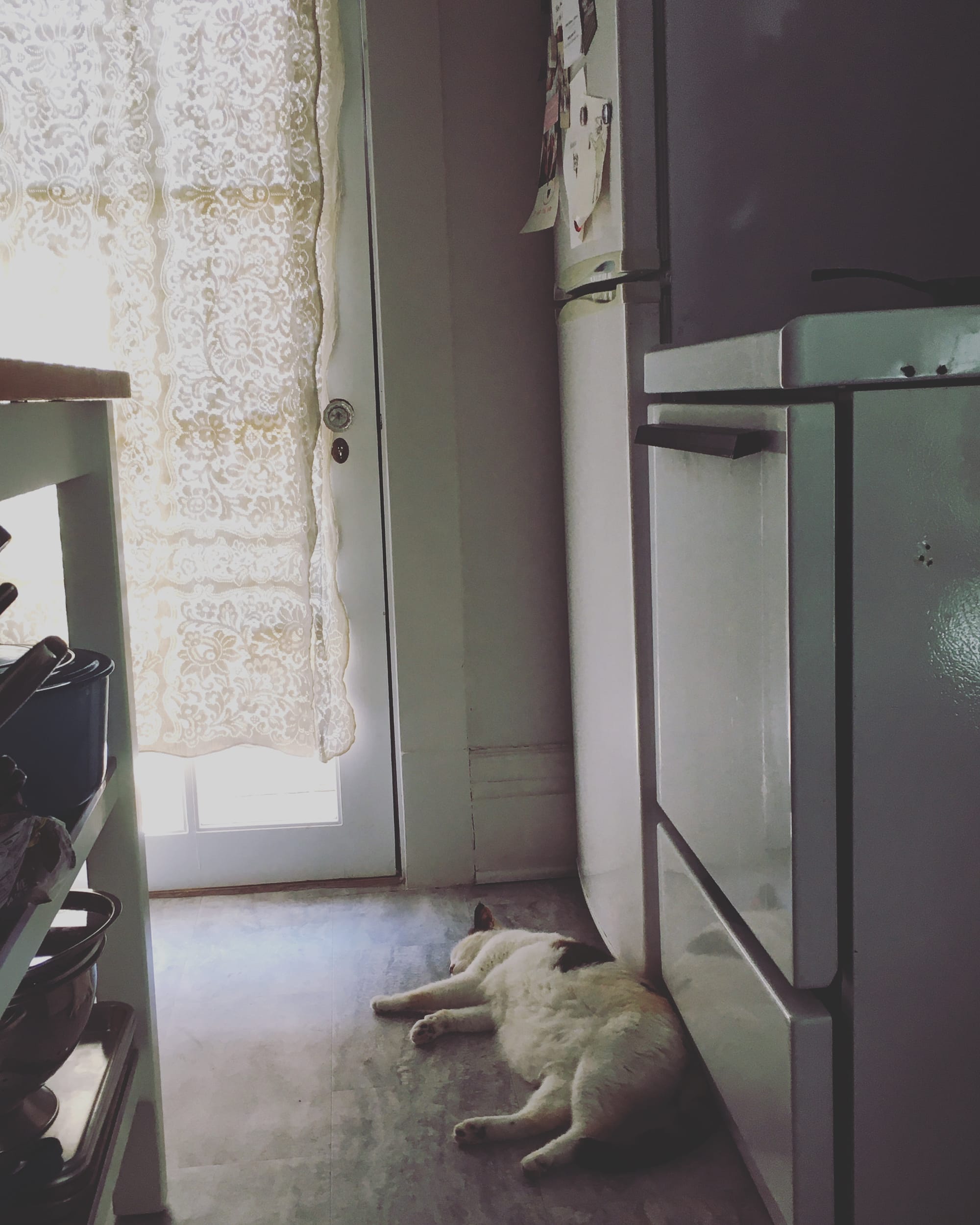
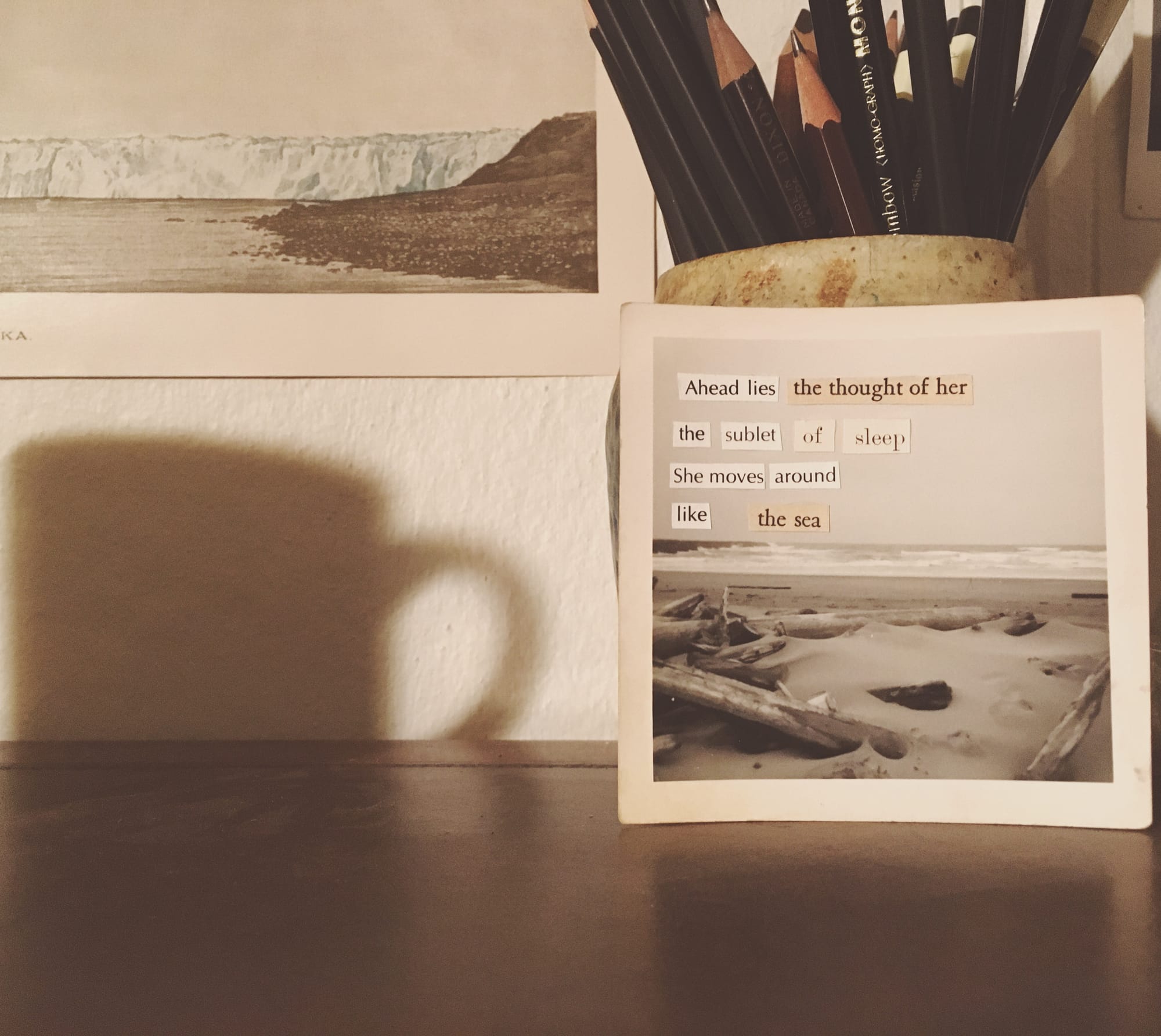
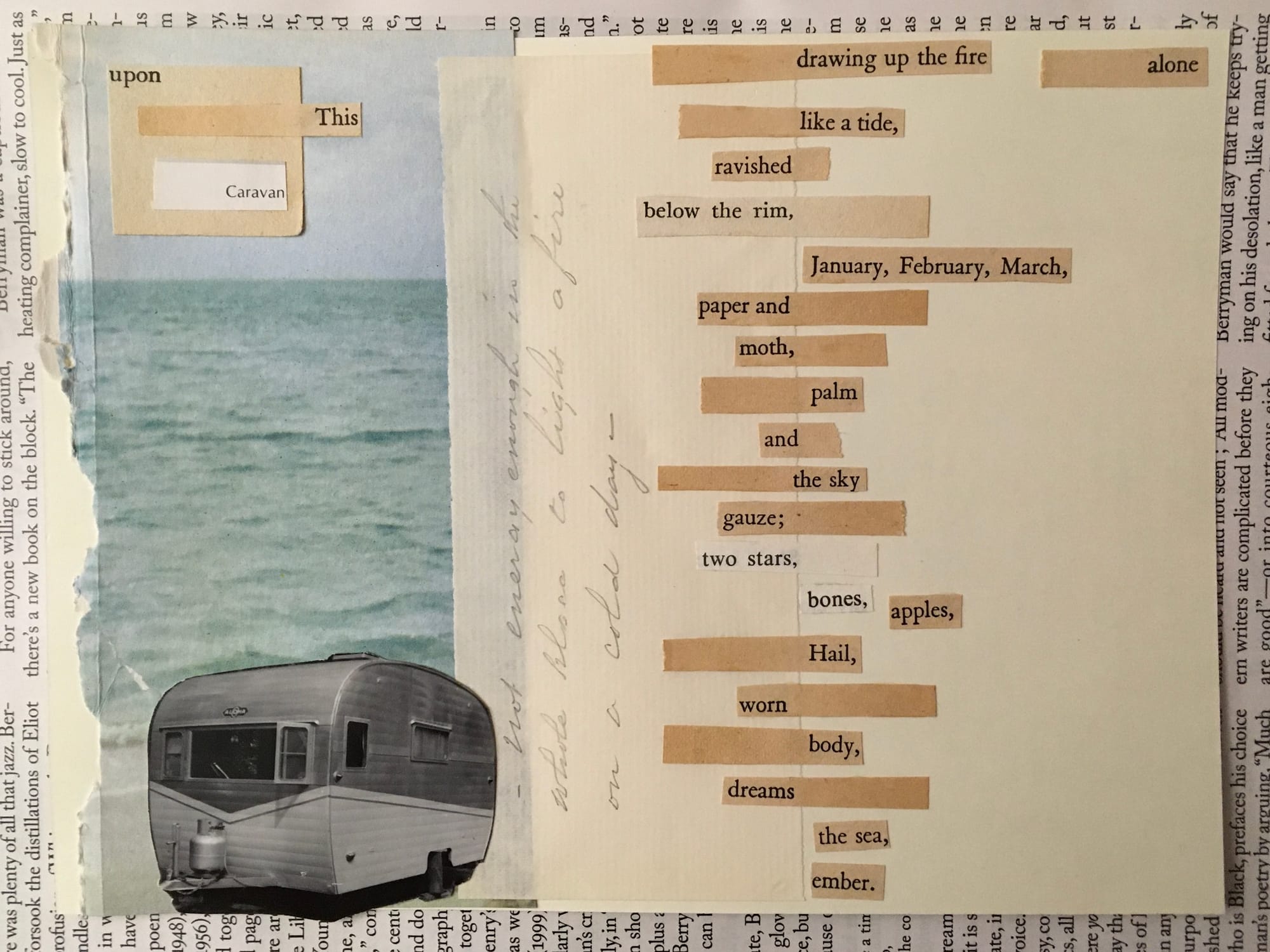
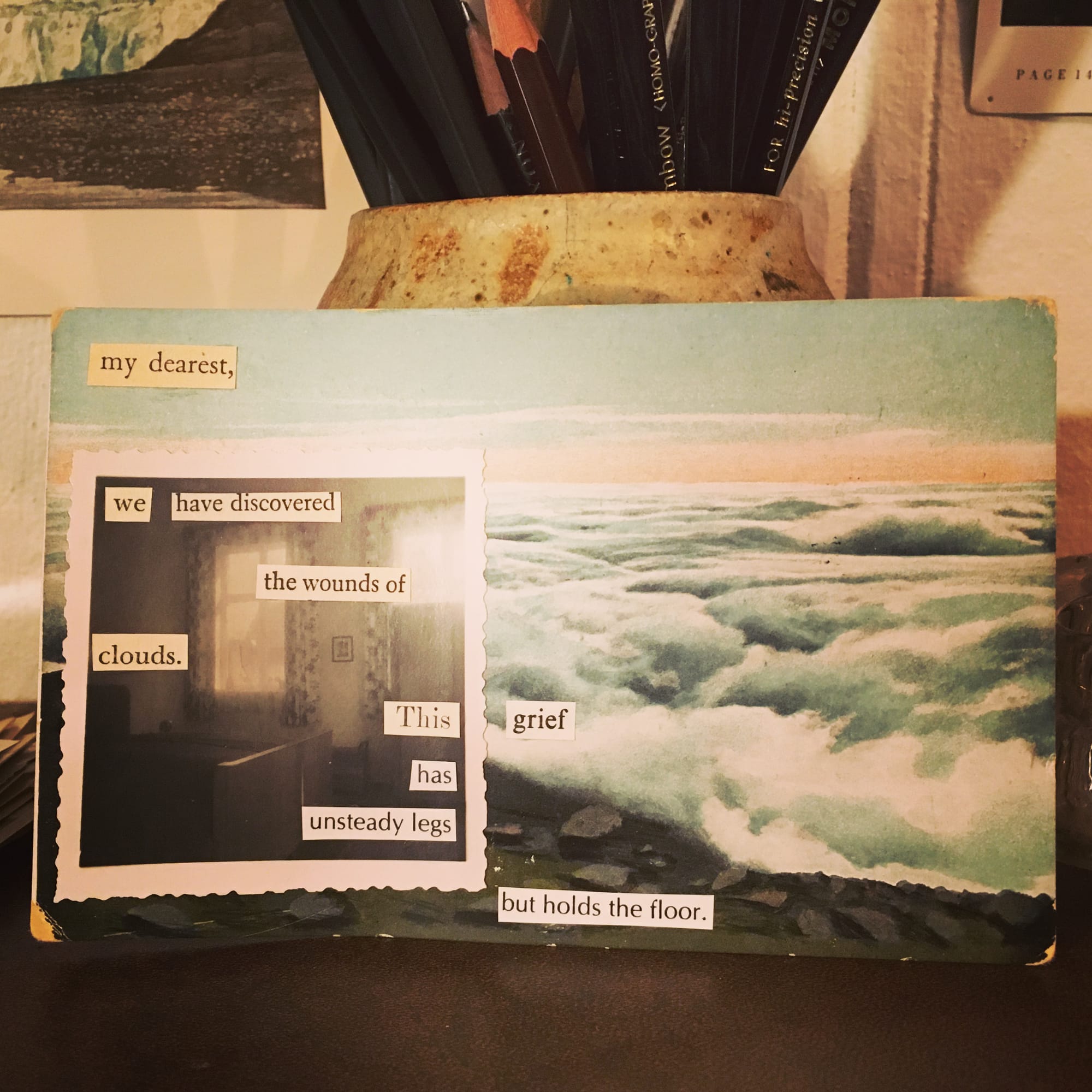
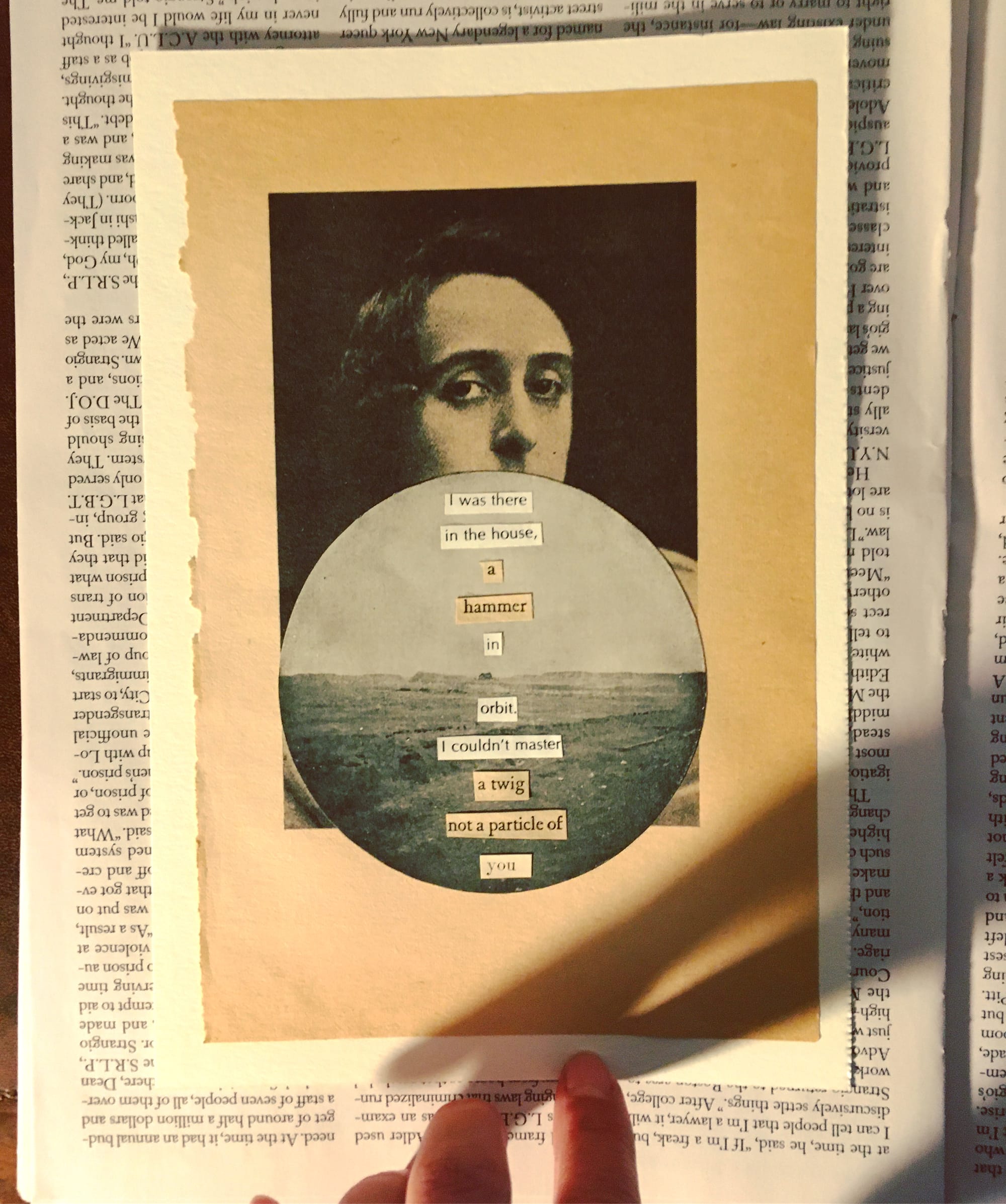
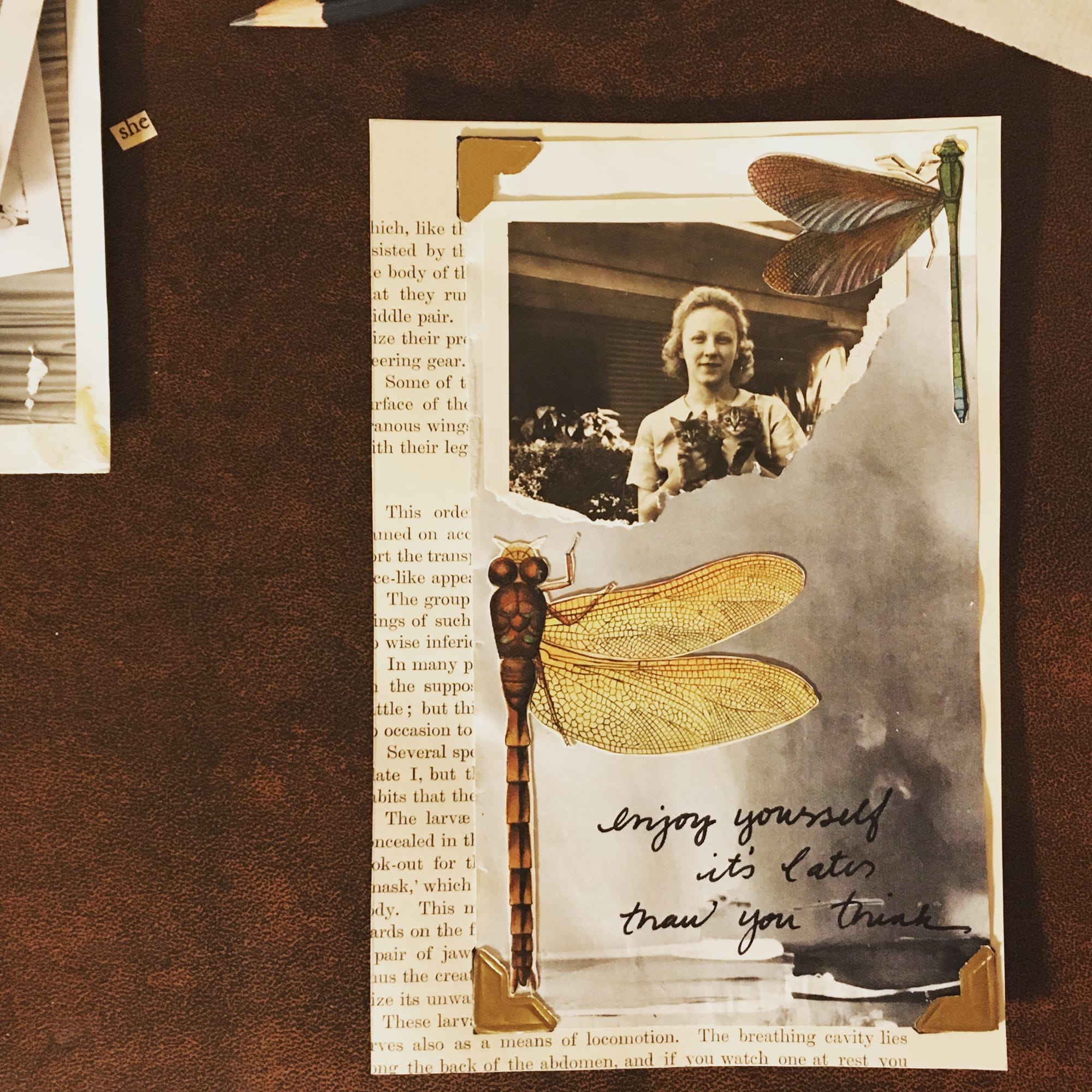
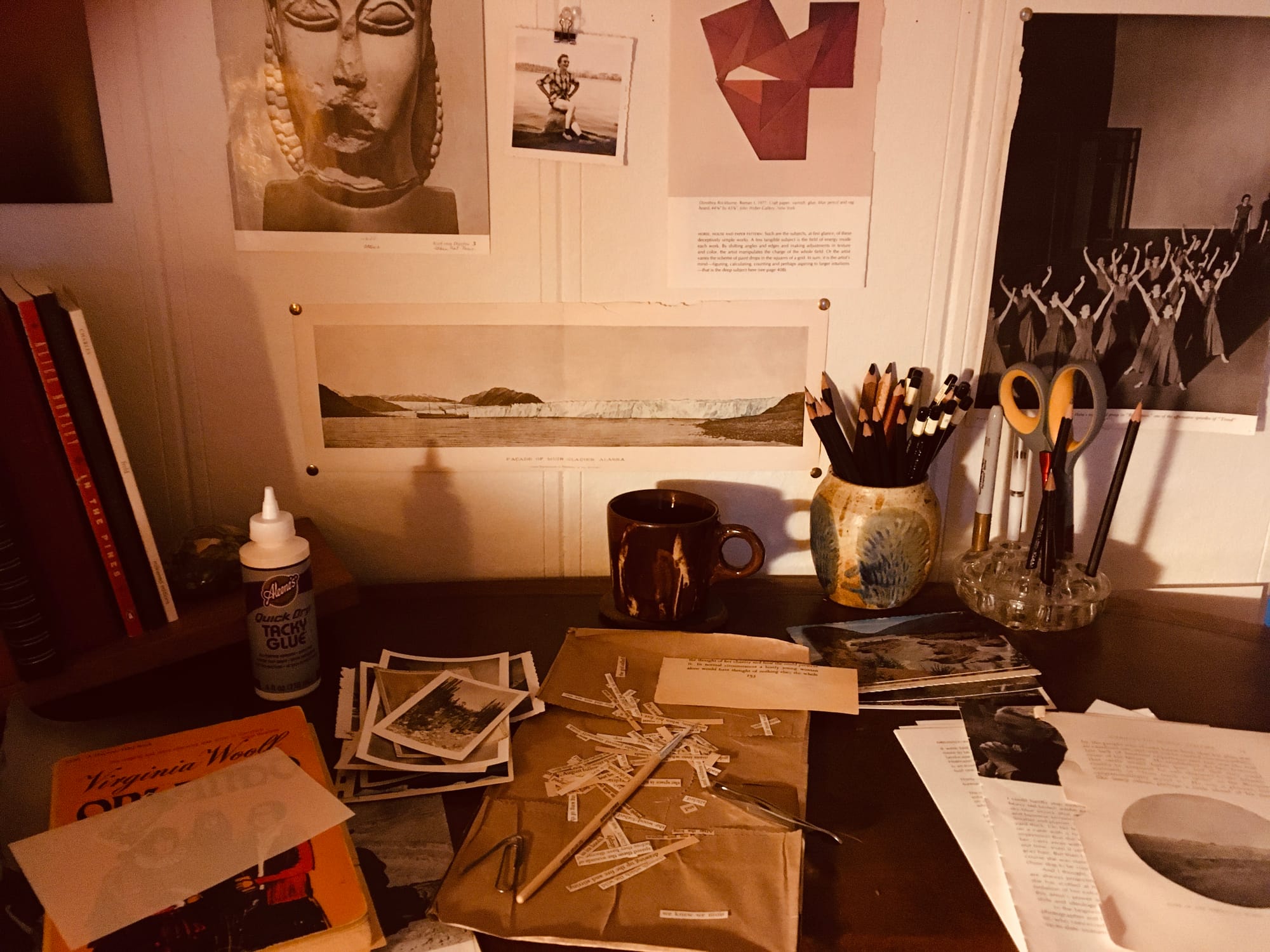
From the top: my workspace in the attic room on South Walnut Street, where I took most of these photographs; I Have Been The Dwelling, an altered postcard; Junebug on the tiny kitchen's floor; sublet, collage poem on found photograph; caravan, for Rye, who was living in a camper trailer in Dingle, Ireland at the time; unsteady, another collage poem; Vita’s Curse, collage poem/art (& my fingers); enjoy yourself, it’s later than you think, a found scrap of a photograph of my Great Aunt Margaret Baker & some damselflies; works in progress, on the desk December 15, 2020.
Of these, Vita’s Curse, which was for a friend’s birthday, still comes into my mind sometimes. The face behind the poem-on-the-prairie is Vita Sackville West; from a beloved, falling-apart copy of Virginia Woolf’s Orlando. Vita couldn’t inherit her family home because she wasn’t a male heir; her lover Virginia Woolf wrote a trans-fabulist novella for her about this. Here’s my collage text, which I have memorized now:
I was there in the house, a hammer in orbit. I couldn’t master a twig, not a particle of you.
I think it captures my state of mind at the time: house-bound, embodied; clumsily trying to reckon with often overwhelming feelings of insignificance, alienation and loneliness. I have been the dwelling, also, might point to a theme I circled round and round. That was the second time I had tried sobriety in a serious way, and I needed something to distract myself, to keep me busy channeling the awareness that I wasn’t numbing or dumbing with alcohol.
Almost all of these pieces were given away or mailed to people during the pandemic. (I have been the dwelling is still sitting here on my desk.) Many of these little collages have already fallen apart, and, possibly, were tossed in the bin. That’s okay. It’s all transitory, anyway. I can’t take them with me—not the postcards or the body that desired them in the first place—so I might as well let go of their fates. I’ve captured them in time with my pictures, but the time to make new things— with what I have in front of me—is always now.
Late in 2025 I had an idea to write reviews of out-of-print books on old postcards as a purely anti-capitalist art project. With nothing to promote or sell, just writing my thoughts about an old, forgotten book on an old, forgotten piece of cardstock. I have done one, so far, and have a couple of others on deck. When I have a few of them—what’s a group of postcards called?!— how about a flock?—when I have a flock of them, I’ll set them loose on the world.
Send ye postcards while ye may!
You may have seen the articles in the Guardian and elsewhere about Denmark ending their mail service. I felt a hard pang at that headline, of course. One of you, dear friends, Lauren from the UK, sent me a postcard with word of her local mail carrier’s fears for the Royal Mail Service, as well. My hope is that the people spuriously in charge here won’t want to follow in the footsteps of Denmark :: [pregnant pause; thinking of Greenland] :: but I’m afraid the U.S. might be headed that way, too. (As Rye remarked: if anything else, to prevent vote-by-mail. Because of course they would.)
They’ve already slowed down letter delivery so much. Postcards I sent two weeks ago have just arrived at their destination in Spokane. Even more ridiculous: our friends who live just 1 km away sent us a thank you card that went (with all other letters) to Portland before being processed and sent back to Eugene for delivery. Think of the journey—the migration, if you will—of all the postcards.
I don’t put anything on a postcard that I wouldn’t want to be read by the surveillance state. So, I’ll be sending out a stack of postcards with poems and snippets of poems this week, in honor of Renee Nicole Good and all victims of ICE. If you receive one from me, read between the lines. Maybe you’ll join me?
xoLex